
The era of “ten blue links” is quietly fading. In its place comes AI-driven search – systems that generate answers directly, summarize multiple sources, and often satisfy user intent without a single click. This shift fundamentally changes how visibility, authority, and traffic are earned.
SEO is not dead.
But traditional SEO is no longer sufficient.
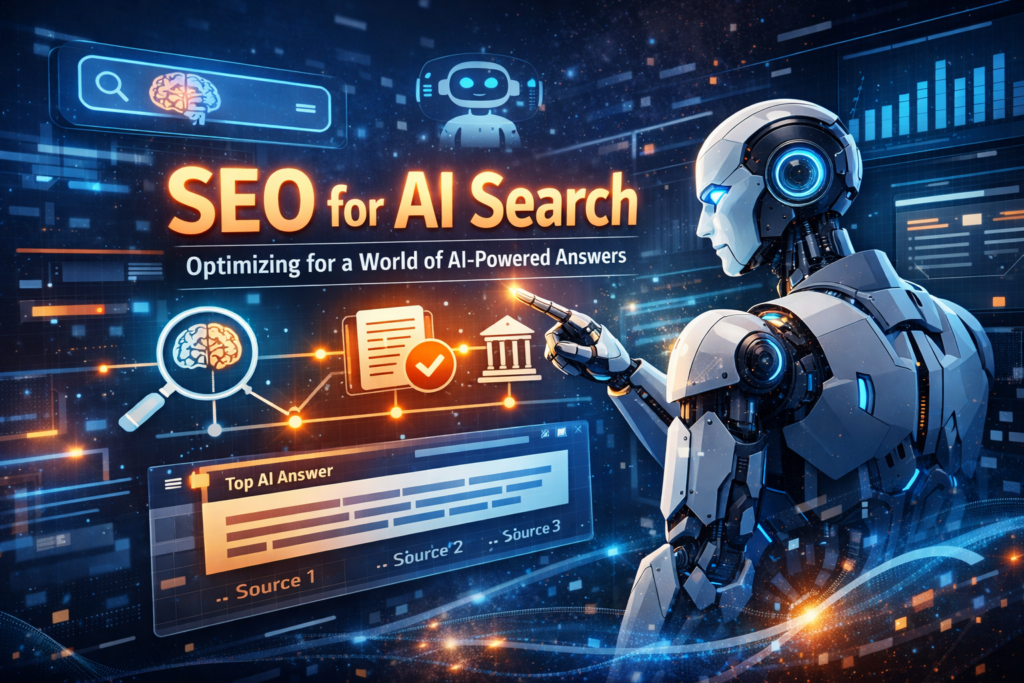
Welcome to SEO for AI Search – optimization not for rankings alone, but for relevance, trust, and inclusion in machine-generated answers.
What Is AI Search?
AI search refers to search experiences where artificial intelligence interprets user intent and generates direct responses instead of merely displaying links. These systems synthesize information from multiple sources, evaluate credibility, and present a consolidated answer.
The most prominent example is Google Search Generative Experience (SGE), but similar principles apply to Bing Copilot, AI assistants, and conversational search interfaces.
Key characteristics of AI search:
- The engine answers questions directly
- Sources are blended and summarized
- Visibility does not guarantee traffic
- Authority outweighs keyword matching
This means websites are no longer competing only for rankings – they are competing to become trusted knowledge sources
Why Traditional SEO Models Are Breaking Down
Classic SEO relied on a predictable loop:
Keyword → Ranking → Click → Conversion
AI search disrupts this cycle.
Now the loop looks like this:
Intent → Interpretation → Synthesis → Answer
In many cases, the user never clicks through. The AI has already done the work.
This creates three major challenges:
- Reduced organic traffic, even for high rankings
- Loss of control over how content is presented
- Increased importance of authority and trust signals
Optimizing purely for keywords, backlinks, or meta tags without deeper content quality is no longer enough.
How AI Systems Evaluate and Select Content
AI search engines do not “read” content the way humans do. They analyze it as a knowledge structure.
The following factors matter most:
1. Topical Depth and Semantic Coverage
AI favors content that fully explains a topic, not just fragments of it.
- Clear definitions
- Logical progression of ideas
- Coverage of related subtopics
- Context, not repetition
Thin content, even if optimized for keywords, is usually ignored.
2. Clear Structure and Information Hierarchy
Well-structured content is easier for AI to parse and reuse.
Effective structures include:
- Descriptive headings (H2, H3)
- Bullet points and numbered steps
- FAQ-style explanations
- Concise summaries and conclusions
Think less like a blog post and more like a reference document written for humans.
3. EEAT Is No Longer Optional
Google’s EEAT framework – Experience, Expertise, Authoritativeness, Trustworthiness – has become foundational in AI search.
AI systems actively look for signals such as:
- Demonstrated first-hand experience
- Consistent expertise across content
- Author identity and credibility
- Clear, confident explanations
Anonymous, generic, or purely AI-generated texts without human perspective tend to perform poorly.
Zero-Click Search: Threat or Opportunity?
Zero-click search is often framed as a loss. In reality, it is a shift in value.
Even when users do not click:
- Your brand may be mentioned
- Your content may be paraphrased
- Your expertise may shape perception
In AI search, visibility precedes traffic.
Sites that consistently appear as sources in AI answers often benefit from:
- Increased brand searches
- Direct visits
- Higher trust in later conversion stages
SEO for AI search is not about forcing clicks – it is about owning the narrative.
How to Create Content That AI Search Uses
1. Write for Understanding, Not Algorithms
Clarity beats optimization tricks.
2. Answer Questions Completely
One topic per page. No fragmentation.
3. Use Natural, Human Language
Over-optimized text feels artificial – and AI detects that.
4. Include Context and Insight
Explain why something matters, not just what it is.
5. Show Perspective
AI prefers content with a clear, confident point of view over neutral rehashes.
Technical Foundations Still Matter
Content quality is central, but technical SEO remains the infrastructure.
Minimum requirements include:
- Fast page speed
- Clean HTML and logical DOM structure
- Proper heading hierarchy
- Structured data (Article, FAQ, HowTo schema)
- Canonical clarity and crawl efficiency
AI systems do not tolerate chaos.
They reward order.
The Strategic Shift: From Traffic to Trust
The most important change in SEO for AI search is philosophical.
SEO is no longer about gaming systems.
It is about earning inclusion.
Ask yourself:
- Does this content genuinely help someone understand the topic?
- Would it still be valuable if rankings disappeared?
- Does it sound like it was written by someone who knows what they are talking about?
If the answer is yes, AI search is more likely to use it.
The Future of SEO in an AI-Driven Web
AI search will continue to evolve. Answers will become more personalized, more conversational, and more selective in their sources.
Websites that will succeed are those that:
- Build deep topical authority
- Maintain consistent quality
- Embrace transparency and expertise
- Stop chasing loopholes
In a way, AI search brings SEO back to its original purpose:
helping people find reliable answers.
SEO for AI Search is not about tricks, hacks, or shortcuts.
It is about:
- Less keyword obsession
- More meaning
- Less noise
- More clarity
- Less manipulation
- More trust
Search engines no longer shout results.
They whisper conclusions.
